Fast Fourier Transform
Pure-Rust, no-std-first FFT integrated with the crate's Complex and SIMD support.
Requires the fft Cargo feature:
Not FFTW
FFTW's speed comes from runtime planning, autotuned codelets, and a large C codebase
that cannot run under no_std / no-alloc — the target numeris was built for. The goal
here is portable, zero-C-dependency FFT that also runs on embedded, integrated with
the rest of the crate. On desktop, expect roughly 2–4× FFTW throughput; for the audience
that reaches for numeris (embedded DSP, no allocator) that is a non-issue, because FFTW
is not an option there.
Sign convention: the forward transform uses \(X_k = \sum_n x_n\, e^{-2\pi i kn/N}\); the
inverse is normalized by \(1/N\) so that ifft(fft(x)) == x.
Two tiers
| Tier | API | Allocation | Sizes |
|---|---|---|---|
| Fixed-size | fft / ifft / fft_inplace / ifft_inplace |
none (stack) | power-of-two N ≤ 4096 |
| Real, fixed | rfft / irfft |
none (stack) | power-of-two N ≤ 4096 |
| Runtime | DynFft |
alloc |
any length |
| Real, runtime | DynRealFft |
alloc |
any length |
| 2D | DynFft2 / DynRealFft2 |
alloc |
any rows × cols |
Fixed-size complex FFT (no-alloc)
In-place over [Complex<T>; N] for power-of-two N ≤ 4096 (checked at compile time).
fft / ifft take a precomputed TwiddleTable so no sin/cos runs in the loop —
the path to prefer when repeating a fixed transform size on embedded. fft_inplace /
ifft_inplace generate stage twiddles inline (no persistent table).
use numeris::fft::{fft_inplace, ifft_inplace};
use numeris::Complex;

let mut buf = [
    Complex::new(1.0f64, 0.0),
    Complex::new(2.0, 0.0),
    Complex::new(3.0, 0.0),
    Complex::new(4.0, 0.0),
];
fft_inplace(&mut buf);
assert!((buf[0].re - 10.0).abs() < 1e-12); // DC bin = sum of inputs
ifft_inplace(&mut buf);
assert!((buf[0].re - 1.0).abs() < 1e-12);
With a reusable table:
use numeris::fft::{fft, TwiddleTable};
use numeris::Complex;

let tw = TwiddleTable::<f64, 8>::new(); // build once
let mut buf = [Complex::new(0.0, 0.0); 8];
buf[1] = Complex::new(1.0, 0.0);
fft(&mut buf, &tw); // reuse across many transforms
TwiddleTable<f64, 4096> occupies 64 KiB (full-N storage keeps the type on stable
Rust). Memory-constrained callers should use fft_inplace or a smaller N.
Runtime-sized FFT — DynFft (requires alloc)
Build a plan once, reuse it. Power-of-two lengths transform through the SIMD-accelerated radix core; any other length — including primes — goes through Bluestein's algorithm, which reduces the DFT to power-of-two FFTs. No dedicated radix-3/5 kernels are needed.
use numeris::fft::DynFft;
use numeris::Complex;

let mut plan = DynFft::<f64>::new(1000); // 1000 = 2^3 · 5^3, mixed length
let mut buf: Vec<Complex<f64>> = (0..1000).map(|i| Complex::new(i as f64, 0.0)).collect();
plan.forward(&mut buf);
plan.inverse(&mut buf);
assert!((buf[1].re - 1.0).abs() < 1e-9);

let mut prime = DynFft::<f64>::new(1009); // prime -> Bluestein
# let mut b: Vec<Complex<f64>> = (0..1009).map(|i| Complex::new(i as f64, 0.0)).collect();
# prime.forward(&mut b);
forward / inverse panic if the buffer length does not equal the plan length.
Sharing a plan across threads
A plan's twiddles are read-only during a transform — the only mutable state is the
scratch. forward / inverse use the scratch the plan carries internally (hence
&mut self); to run one plan from several threads, or to keep it behind a shared
reference, build a scratch per worker with make_scratch and call forward_with /
inverse_with:
use numeris::fft::DynFft;
use numeris::Complex;

let plan = DynFft::<f64>::new(1024);          // shared, immutable
let mut scratch = plan.make_scratch();        // one per worker
let mut frame = vec![Complex::new(1.0, 0.0); 1024];
plan.forward_with(&mut frame, &mut scratch);  // `&plan`
A scratch is tied to the length it was built for (passing it to a plan of another length
panics). DynRealFft has the same make_scratch / forward_with / inverse_with trio.
This is the mechanism the 2D transforms use to batch rows and columns under rayon.
Real-input transforms
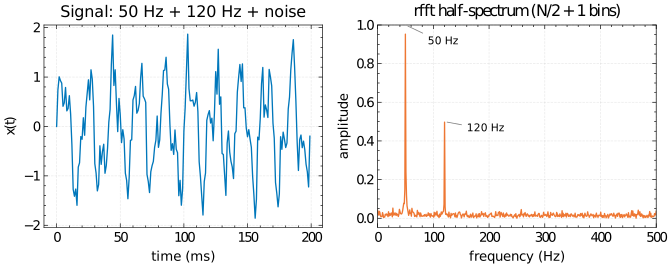
A length-N real signal has a Hermitian spectrum, so only the N/2 + 1 non-redundant
bins (DC … Nyquist) are computed. The forward transform packs the reals into N/2
complex samples for roughly half the work. Output length is passed as a caller-supplied
slice (returning [_; N/2+1] would need unstable const generics).
use numeris::fft::{rfft, irfft};
use numeris::Complex;

let signal = [1.0f64, 2.0, 3.0, 4.0, 3.0, 2.0, 1.0, 0.0];
let mut spec = [Complex::new(0.0, 0.0); 8 / 2 + 1]; // 5 bins
rfft(&signal, &mut spec);

let mut recovered = [0.0f64; 8];
irfft(&spec, &mut recovered);
assert!((recovered[0] - 1.0).abs() < 1e-12);
Both directions use the half-size trick: the inverse re-tangles the N/2 + 1 bins into
the length-N/2 spectrum of the packed sequence and runs one length-N/2 inverse FFT, so
irfft costs about the same as rfft. DynRealFft is the runtime-sized equivalent (even
lengths use the half-size trick both ways; odd lengths use a full complex FFT).
Convolution and correlation (requires alloc)
FFT-based linear convolution / cross-correlation of real signals. Output length is
a.len() + b.len() - 1.
use numeris::fft::fft_convolve;

let a = [1.0f64, 2.0, 3.0];
let b = [0.5, 1.0];
let c = fft_convolve(&a, &b); // length 4
The operands are zero-padded to the next power of two above the output length and transformed with a real-input plan, so the transforms always take the SIMD radix path (never Bluestein) and only the half-spectrum is multiplied. For small kernels a direct convolution is faster; the FFT path wins once both operands are large.
2D convolution
fft_convolve2d / fft_correlate2d are the same thing for DynMatrix operands: the
"full" (ra + rb − 1) × (ca + cb − 1) linear convolution / correlation via DynRealFft2
at the next power of two along each axis. The cost is O(N log N) in the padded size
regardless of kernel size, which is the win over spatial imageproc::convolve2d
(O(N·k²)) for large kernels — big-radius Gaussian / LoG, template matching.
use numeris::fft::{fft_convolve2d, fft_correlate2d};
use numeris::DynMatrix;

let image = DynMatrix::from_fn(64, 80, |r, c| ((r * 7 + c * 13) % 251) as f64);
let kernel = DynMatrix::from_fn(15, 15, |r, c| (-(((r as f64 - 7.0).powi(2) + (c as f64 - 7.0).powi(2)) / 18.0)).exp());
let full = fft_convolve2d(&image, &kernel);      // 78 × 94
assert_eq!((full.nrows(), full.ncols()), (64 + 15 - 1, 80 + 15 - 1));
let peaks = fft_correlate2d(&image, &kernel);    // template-matching response
For the "same"-sized result centered on the image, crop kernel.nrows()/2 rows and
kernel.ncols()/2 columns off the top-left (e.g. with imageproc::crop); the boundary is
zero-padded, matching BorderMode::Zero.
2D FFT (requires alloc)
The 2D DFT is separable: an rows × cols transform is a batch of 1D FFTs along each
axis (every column, then every row — order does not matter), so DynFft2 is built entirely
on DynFft and inherits Bluestein for non-power-of-two dimensions. Data is a column-major
DynMatrix<Complex<T>>, so the column pass slices contiguous columns straight out of the
backing buffer. The row axis is strided, so the row pass runs on a cache-blocked
transposed copy held by the plan: transpose, batch-transform the now-contiguous columns,
transpose back. Both passes therefore hit the contiguous SIMD path.
Under the rayon feature each pass (and each transpose) fans out over columns above the
crate's shared work gate — every column is disjoint output, the plan is shared read-only,
and each worker brings its own scratch — so results are identical to the sequential path.
A single 1D transform is never multithreaded (its stages form a serial chain).
use numeris::fft::DynFft2;
use numeris::{DynMatrix, Complex};

let mut plan = DynFft2::<f64>::new(4, 4);
let mut img = DynMatrix::from_fn(4, 4, |r, c| Complex::new((r + c) as f64, 0.0));
plan.forward(&mut img);
plan.inverse(&mut img); // normalized by 1/(rows*cols)
assert!((img[(1, 2)].re - 3.0).abs() < 1e-10);
DynRealFft2 transforms a real rows × cols image into a (rows/2 + 1) × cols complex
half-spectrum (real FFT along the contiguous column axis, full complex FFT along the row
axis) — roughly half the cost and storage, the form image processing wants.
use numeris::fft::DynRealFft2;
use numeris::{DynMatrix, Complex};

let mut plan = DynRealFft2::<f64>::new(6, 4);
let real = DynMatrix::from_fn(6, 4, |r, c| (r as f64).sin() + c as f64);
let mut spec = DynMatrix::zeros(6 / 2 + 1, 4); // (rows/2+1) × cols
plan.forward(&real, &mut spec);
let mut recon = DynMatrix::zeros(6, 4);
plan.inverse(&spec, &mut recon);
Spectrum centering
fftshift / ifftshift are no-alloc, in-place, and generic over any element type — pure
rotations. fftshift moves the zero-frequency component to the center (NumPy semantics);
ifftshift is its exact inverse for odd lengths.
use numeris::fft::{fftshift, ifftshift};

let mut v = [0, 1, 2, 3, 4];
fftshift(&mut v);
assert_eq!(v, [3, 4, 0, 1, 2]);
ifftshift(&mut v);
assert_eq!(v, [0, 1, 2, 3, 4]);
fftshift2d / ifftshift2d are the 2D analogue for a DynMatrix — they swap diagonal
quadrants (a 1D shift along each axis) and allocate nothing.
use numeris::fft::{fftshift2d, ifftshift2d};
use numeris::DynMatrix;

let mut m = DynMatrix::from_fn(4, 4, |r, c| (r * 4 + c) as f64);
fftshift2d(&mut m);   // DC at (0,0) moves to the center
ifftshift2d(&mut m);  // exact inverse
Performance notes
- The
DynFftpower-of-two path deinterleaves into structure-of-arrays real/imaginary buffers and runs radix-2 butterflies through SIMD kernels (NEON / SSE2 / AVX / AVX-512 via compile-time dispatch, scalar fallback otherwise). - The no-std fixed tier stays scalar: its audience is embedded (small
N, code-size-sensitive), where deinterleave scratch would undercut the low-memory point. - The length-2 and length-4 butterfly stages (trivial twiddles
1and−i) are fused into one twiddle-free pass instead ofn/2 + n/4kernel calls on 1–2-element blocks. - The remaining stages are radix-4: each sweep over the arrays does the work of two
radix-2 stages with three complex multiplies per four elements (
w, w², w³tables) instead of four, halving memory passes. A single radix-2 stage finishes oddlog2(n). - The bit-reversal permutation is a gather (sequential writes, bit-reversed reads): for
inputs larger than the cache it is 5× cheaper than the scatter form, which had been most
of the transform at
n = 65536. - The inverse reuses the forward kernels via
conj(fft(conj(x)))/N, with both conjugations folded into the deinterleave / interleave copies — no extra pass. - Bluestein trades a prime-length DFT for a power-of-two FFT of length
≥ 2N − 1(run on the same SIMD core), so prime sizes cost a few times a nearby power-of-two size but remainO(N log N). - Real transforms are half-size in both directions; 1D and 2D FFT convolution pad to a power of two and use the real plans.
- 2D: both passes are contiguous (transposed row pass), and batches parallelize under
rayon— see Performance.