ODE Integration¶
numeris provides fixed-step and adaptive ODE integrators for non-stiff and stiff systems. All explicit solvers work on Matrix<T, M, N> states (including Vector<T, N> = Matrix<T, N, 1>) with closure-based dynamics functions — enabling both vector ODE and matrix ODE integration (e.g., state transition matrices, matrix Riccati equations). Rosenbrock (stiff) solvers operate on vector states only.
Requires the ode feature.
Fixed-Step RK4¶
Classic 4th-order Runge-Kutta — no error estimation, fixed step size. For the initial-value problem \(y' = f(t, y)\), one step of size \(h\) is
with local truncation error \(O(h^5)\).
use numeris::ode::{rk4, rk4_step};
use numeris::Vector;

let f = |_t: f64, y: &Vector<f64, 2>| {
    Vector::from_array([y[1], -y[0]])  // harmonic oscillator
};

let y0 = Vector::from_array([1.0_f64, 0.0]);
let dt = 0.01;
let t_end = 2.0 * std::f64::consts::PI;

// Integrate from t=0 to t=t_end
let sol = rk4(0.0, t_end, dt, &y0, f);

// Or take a single step
let y1 = rk4_step(0.0, &y0, dt, f);
RK4 is fully no-std and no-alloc — suitable for embedded real-time control loops.
Adaptive Solvers¶
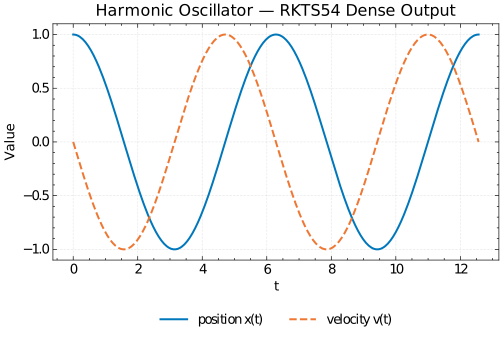
Seven adaptive Runge-Kutta solvers via the RKAdaptive trait. All use embedded error estimation and a PI step-size controller (Söderlind & Wang 2006) for automatic step adjustment.
use numeris::ode::{RKAdaptive, RKTS54, AdaptiveSettings};
use numeris::Vector;

let y0 = Vector::from_array([1.0_f64, 0.0]);
let tau = 2.0 * std::f64::consts::PI;

let sol = RKTS54::integrate(
    0.0, tau, &y0,
    |_t, y| Vector::from_array([y[1], -y[0]]),
    &AdaptiveSettings::default(),
).unwrap();

println!("y(2π) = {:?}", sol.y);          // final state
println!("steps taken = {}", sol.accepted); // number of accepted steps
Solver Table¶
| Solver | Stages | Order | FSAL | Interpolant | Best for |
|---|---|---|---|---|---|
RKF45 |
6 | 5(4) | no | — | Classic baseline |
RKTS54 |
7 | 5(4) | yes | 4th degree | General purpose |
RKV65 |
10 | 6(5) | no | 6th degree | Moderate accuracy |
RKV87 |
17 | 8(7) | no | 7th degree | High accuracy |
RKV98 |
21 | 9(8) | no | 8th degree | Very high accuracy |
RKV98NoInterp |
16 | 9(8) | no | — | Very high acc., no dense output |
RKV98Efficient |
26 | 9(8) | no | 9th degree | Max accuracy + dense output |
FSAL (First Same As Last): the last function evaluation of one step is reused as the first of the next, saving one function evaluation per step.
Step-size control and discontinuities¶
Accepted steps are sized by the PI controller. A rejected step is shrunk by the
order-based estimate enorm^(0.7/p) / safety (capped at 1 / min_factor), and
from the second consecutive rejection on by at least 2×. The forced halving
matters when the right-hand side has a kink or discontinuity inside a step (a
switching force, an eclipse boundary, a piecewise control law): there the local
error scales like h rather than h^(p+1), so the order-based shrink alone is
far too gentle for a high-order method and the integrator could exhaust its
rejection budget before stepping past the kink. With the forced halving every
solver steps through a kink in a few dozen rejections at any tolerance; the
TooManyRejections limit (50 consecutive) is reached only when the error cannot
be brought under tolerance at any step size. Smooth problems are unaffected —
they essentially never reject twice in a row.
AdaptiveSettings¶
use numeris::ode::AdaptiveSettings;

let settings = AdaptiveSettings {
    rel_tol: 1e-8,       // relative tolerance (default 1e-8)
    abs_tol: 1e-10,      // absolute tolerance (default 1e-8)
    min_step: 1e-10,     // minimum step size (default 1e-6)
    max_steps: 100_000,  // step limit (default 100_000)
    dense_output: false, // store dense output for interpolation
    h_min: None,         // force acceptance below this step size
    initial_step: None,  // first step to try (None → starting-step heuristic)
    ..AdaptiveSettings::default()
};
Starting step and warm start¶
With initial_step: None the first step comes from the Hairer–Nørsett–Wanner
starting-step heuristic (Solving ODEs I, §II.4): two probe evaluations of f
estimate the first and second derivatives, and the step is sized so that a
first-order error bound is well under tolerance. That bound is deliberately
conservative, and it is scale-sensitive — on a problem whose natural time scale
is far from 1 in the working units (an orbit in metres and seconds, say) a
high-order solver can start several orders of magnitude below its working step
and spend a dozen accepted steps growing into it. For a short integration that
ramp can be most of the cost.
Two settings remove it:
initial_step: Some(h)skips the heuristic and starts at|h|(the sign oftf - t0is applied; a value longer than the interval is clamped to it). A hint within a factor of a few of the working step is enough: too large costs one rejection, too small is grown in a couple of steps. Zero or non-finite values returnOdeError::InvalidInitialStep.sol.next_stepis the step the controller would take aftersol.t. It is the last unclamped proposal — the final step is shortened to land exactly ontf, and that shortening is not reflected — so a follow-on segment can take it as itsinitial_stepand continue at full stride:
use numeris::ode::{RKAdaptive, RKV98, AdaptiveSettings};
use numeris::Vector;

let settings = AdaptiveSettings { rel_tol: 1e-10, abs_tol: 1e-10, ..AdaptiveSettings::default() };
let f = |_t: f64, y: &Vector<f64, 2>| Vector::from_array([y[1], -y[0]]);
let y0 = Vector::from_array([1.0_f64, 0.0]);

let seg1 = RKV98::integrate(0.0, 10.0, &y0, f, &settings).unwrap();
// Continue from seg1 without the cold-start ramp.
let warm = AdaptiveSettings { initial_step: Some(seg1.next_step), ..settings };
let seg2 = RKV98::integrate(10.0, 20.0, &seg1.y, f, &warm).unwrap();
assert!(seg2.evals < RKV98::integrate(10.0, 20.0, &seg1.y, f, &settings).unwrap().evals);
Both apply to the Runge-Kutta solvers and to RODAS4.
Solution struct¶
let sol = RKTS54::integrate(0.0, 1.0, &y0, f, &settings).unwrap();

let y_final  = &sol.y;       // final state Matrix<T, M, N>
let t_final  =  sol.t;       // final time (= t_end if successful)
let n_evals  =  sol.evals;   // total derivative evaluations
let n_accept =  sol.accepted; // number of accepted steps
let n_reject =  sol.rejected; // number of rejected steps
let h_next   =  sol.next_step; // controller's next proposal (warm-start hint)
Dense Output (Interpolation)¶
Solvers with an interpolant can return intermediate values at arbitrary times without re-integrating. Requires std feature (uses Vec internally).
use numeris::ode::{RKAdaptive, RKTS54, AdaptiveSettings};
use numeris::Vector;

let y0 = Vector::from_array([1.0_f64, 0.0]);

let settings = AdaptiveSettings {
    dense_output: true,
    ..AdaptiveSettings::default()
};
let sol = RKTS54::integrate(
    0.0, 6.28, &y0,
    |_t, y| Vector::from_array([y[1], -y[0]]),
    &settings,
).unwrap();

// Interpolate at arbitrary time point
let y_at_pi = RKTS54::interpolate(std::f64::consts::PI, &sol).unwrap();
// y[0] ≈ -1.0 (cosine at π)
Stiff Solver: RODAS4¶
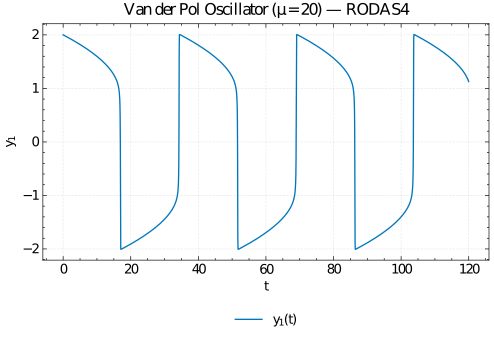
For stiff ODEs (chemical kinetics, circuit simulation, orbital mechanics with drag), use RODAS4 — an L-stable linearly-implicit Rosenbrock method. It solves linear systems involving the Jacobian instead of nonlinear Newton iterations, making it suitable for very stiff problems without tuning.
use numeris::ode::{Rosenbrock, RODAS4, AdaptiveSettings};
use numeris::{Vector, Matrix};

// Stiff decay: y' = -1000y,  y(0) = 1
let y0 = Vector::from_array([1.0_f64]);

// With user-supplied Jacobian
let sol = RODAS4::integrate(
    0.0, 0.01, &y0,
    |_t, y| Vector::from_array([-1000.0 * y[0]]),
    |_t, _y| Matrix::new([[-1000.0_f64]]),
    &AdaptiveSettings::default(),
).unwrap();
assert!((sol.y[0] - (-10.0_f64).exp()).abs() < 1e-8);

// With automatic finite-difference Jacobian (no need to supply ∂f/∂y)
let sol2 = RODAS4::integrate_auto(
    0.0, 0.01, &y0,
    |_t, y| Vector::from_array([-1000.0 * y[0]]),
    &AdaptiveSettings::default(),
).unwrap();
Van der Pol oscillator¶
use numeris::ode::{Rosenbrock, RODAS4, AdaptiveSettings};
use numeris::{Vector, Matrix};

let mu = 20.0_f64;
let y0 = Vector::from_array([2.0_f64, 0.0]);

let sol = RODAS4::integrate(
    0.0, 120.0, &y0,
    |_t, y| Vector::from_array([
        y[1],
        mu * (1.0 - y[0] * y[0]) * y[1] - y[0],
    ]),
    |_t, y| Matrix::new([
        [0.0,                                    1.0],
        [-2.0 * mu * y[0] * y[1] - 1.0, mu * (1.0 - y[0] * y[0])],
    ]),
    &AdaptiveSettings::default(),
).unwrap();
RODAS4 Properties¶
| Property | Value |
|---|---|
| Stages | 6 |
| Order | 4(3) embedded pair |
| L-stable | Yes (no oscillation for arbitrarily large step sizes) |
| Stiffly accurate | Yes |
| Jacobian | User-supplied or auto finite-difference |
Error Handling¶
use numeris::ode::OdeError;

match RKTS54::integrate(0.0, 1.0, &y0, f, &settings) {
    Ok(sol) => { /* success */ }
    Err(OdeError::MaxStepsExceeded) => { /* increase max_steps or rel_tol/abs_tol */ }
    Err(OdeError::StepNotFinite) => { /* NaN/Inf in state — check dynamics */ }
    Err(OdeError::TooManyRejections) => { /* >50 consecutive rejections: tolerance unreachable — loosen tolerances or set h_min */ }
    Err(OdeError::SingularJacobian) => { /* RODAS4: Jacobian is singular */ }
    _ => {}
}